Technical details
Hydraulic presses: operation, features and industrial applications

5/10/2026
The hydraulic presses represent a fundamental technology in numerous industrial processes where it is necessary to apply force, precision and control in a reliable and repeatable manner. Used in sectors such as metalworking, the automotive industry, industrial manufacturing and material processing, these machines enable the execution of complex operations such as stamping, forming, deep drawing, straightening and assembly with high quality standards.
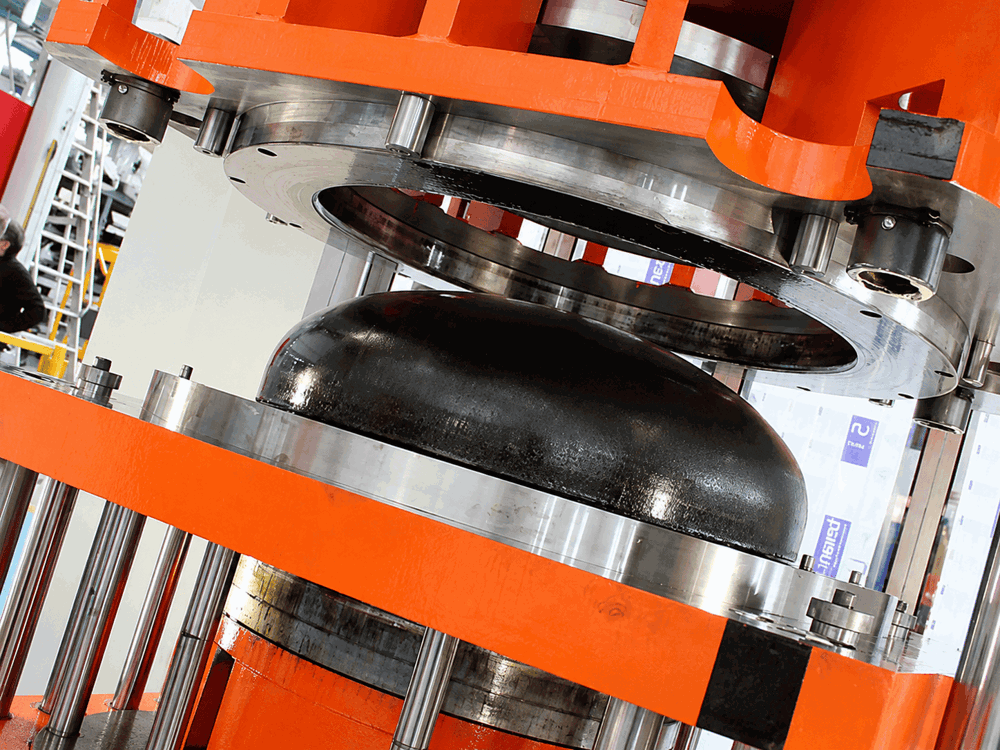
Today, choosing a hydraulic press means not only assessing the force developed, but also considering aspects such as operating speed, energy efficiency, cycle precision and integration into modern production processes.
In this article we examine what hydraulic presses are, how they work, which features make them essential in the most advanced industrial contexts, in which applications they are mainly used today and what Galdabini offers: long design experience, advanced technological solutions and an approach oriented to the real needs of industry.
What hydraulic presses are
The hydraulic presses are industrial machines designed to generate high compressive forces through the use of a hydraulic system.
Thanks to this principle, they are used in all processes where it is necessary to deform, compress, assemble or shape a material in a controlled and precise way.
Compared to other pressing technologies, a hydraulic press allows the force to be managed progressively and accurately throughout the entire working stroke, offering greater control over the process and considerable application versatility. Precisely for these characteristics, hydraulic presses are used in numerous production contexts, from metalworking to stamping, up to special applications that require high reliability, repeatability and operational precision.
In particular, Galdabini industrial hydraulic presses are also designed to integrate within automated production lines, helping to improve efficiency, safety and traceability of the process.
How a hydraulic press works
The operation of a hydraulic press is based on a hydraulic system that uses the pressure of a fluid to generate force. Inside the machine, a hydraulic pump pressurizes the oil which is transferred to the cylinders, allowing controlled movement of the ram and application of the force required for the operation.
One of the elements that make hydraulic presses particularly effective is the ability to precisely control every phase of the cycle. Parameters such as speed, position, pressure and force can be adjusted with extreme accuracy, allowing the machine to be adapted to different operations and materials with specific characteristics.
During the process, a hydraulic press can maintain constant force throughout the stroke, a fundamental characteristic in applications that require high precision or controlled deformations, such as stamping and deep drawing.
Modern hydraulic presses also integrate advanced control systems that enable continuous process monitoring and collection of production data. This approach improves production quality, reduces waste and ensures greater repeatability of results, especially in the most demanding industrial sectors.
Which operations can be performed
Hydraulic presses are used in a wide range of industrial operations thanks to their ability to develop high force with extremely precise process control. Common applications include stamping, forming, deep drawing, straightening, compression and assembly operations for mechanical components.
Depending on the machine configuration and production needs, a hydraulic press can be used for both simple, repetitive operations and more complex processes that require precision, force control and constant monitoring of working parameters. This versatility makes hydraulic presses a strategic solution in many industrial contexts, where finished part quality, reliability and production continuity are essential factors.
Main features of a hydraulic press
The performance of a hydraulic press depends not only on the force it can develop, but on a set of technical features that directly affect production process quality, machining precision and overall plant efficiency. Force control, repeatability, operational flexibility and cycle management are indeed fundamental elements for evaluating a hydraulic press in an industrial environment.
Force and process control
One of the main advantages of hydraulic presses is the ability to develop high forces progressively and controllably, adapting the applied pressure to the specific needs of the operation. This allows precise management of each phase of the cycle, maintaining control over parameters such as speed, pressure, stroke and dwell time under load. The ability to fine-tune these values enables process optimization, reduces the risk of defects on the part and ensures consistent quality even in repetitive or high-intensity production.
Precision and repeatability
In many industrial contexts, precision concerns not only the final result but also the machine’s ability to repeat the same operation while maintaining the set parameters. A high-quality hydraulic press must guarantee repeatability of positioning, stability during the cycle and accurate control of the applied force. These characteristics become particularly important in applications where even minimal variations can affect product quality, dimensional tolerances or the reliability of the production process.
Flexibility and production efficiency
Hydraulic presses are also valued for their high application flexibility. They can be configured for very different operations, adapting to various materials, geometries and production processes. Added to this is the possibility of integrating advanced control systems, automation and intelligent process parameter management, with concrete advantages in terms of operating speed, reduction of setup times and optimization of consumption. In an industrial context increasingly focused on productivity and precision, a modern hydraulic press must therefore be able to combine force, control and maximum operational efficiency.
Galdabini hydraulic presses: performance, precision and advanced design
Galdabini hydraulic presses have always been designed to offer high performance, working precision and advanced control of the production process. The experience gained in designing hydraulic presses and developing industry-dedicated solutions has enabled the company to produce machines that combine power, speed, reliability and ease of use.
Added to these aspects is particular attention to structural compactness, rigidity and the evolution of management software systems, elements that help make Galdabini presses a technologically advanced solution for numerous production contexts.
High performance and production cycle optimization
One of the characteristics that has always distinguished Galdabini hydraulic presses is the high level of performance. The company's long experience in the design and construction of hydraulic circuits makes it possible to achieve an optimal ratio between installed power and working speed, an element that directly affects cycle efficiency. This balance allows the force required for the operation to be developed without compromising speed and operational continuity, with concrete advantages in terms of productivity, cycle time optimization and efficient management of the industrial process.
Monolithic, compact structures designed for precision
The structures of Galdabini presses are manufactured with a monolithic configuration, a design choice that ensures high standards of rigidity and precision even under the most demanding working conditions. A particularly rigid structure helps maintain consistent machine behavior during the cycle, improving machining accuracy and process repeatability.
Alongside structural robustness, Galdabini also pays particular attention to space optimization: the presses are designed to be extremely compact, with a layout engineered to minimize the machine’s footprint and that of its components, a particularly important aspect in many modern production environments.
HMI software and intelligent process management
Ease of use is another central element in the design of Galdabini hydraulic presses. For this reason, particular attention has been devoted to the development of the management software HMI FormTech, designed to make interaction with the machine faster, more intuitive and efficient. Through the system it is possible to introduce new work recipes simply and immediately, reducing configuration times and facilitating operator activity.
In addition, the software automatically acquires and optimizes working parameters, avoiding the need to manually set operational dimensions and braking parameters. This approach simplifies cycle management and reduces the margin for error during setup and production.
Advanced press control and data traceability
The most recent developments introduced in Galdabini presses also concern the advanced control of the stamping process.
Among the most relevant aspects is the high precision in repeatability of positioning during stroke reversal and the monitoring of the correspondence between the set force values and those actually detected during the work cycle. These data can be displayed and stored as graphs, offering the operator real-time control of the production process. In the presence of anomalies, such as incorrect thickness or material rupture, the system can promptly intervene by stopping the cycle. At the same time, the possibility of recording the actual force values applied for each produced piece allows improvement of traceability, quality control and monitoring of the entire production process.
Fields of application of hydraulic presses
Thanks to their ability to develop high force with precise control of working parameters, hydraulic presses are used in numerous industrial sectors and in very different applications. Their versatility allows them to be adapted to specific operations, automated production processes and contexts where precision, repeatability and reliability are essential requirements.
Metal stamping and forming
One of the main application areas of hydraulic presses is metal stamping and forming operations. In these processes, the ability to precisely control the applied force and the machine stroke allows the material to be deformed progressively and accurately, obtaining components that meet required specifications.
Hydraulic presses are used in operations such as deep drawing, bending, blanking, calibration and forming of metal components, even for complex geometries or processes that require high precision control.
Automotive sector and components
In the automotive sector, hydraulic presses are used for the production and processing of numerous components, where precision, speed and repeatability are fundamental. They can be employed for assembly, forming, straightening and stamping operations of mechanical or structural parts, helping to maintain high quality standards even in high-intensity production. The possibility of integrating advanced controls and process parameter monitoring makes these machines particularly suitable for a sector where reliability and quality control are indispensable.
High-precision industrial processing
Hydraulic presses are also used in all production contexts where it is necessary to maintain a high level of precision during processing. Sectors such as mechanical engineering, the production of technical components and special industrial processes require machines capable of ensuring constant force control, positioning repeatability and production cycle monitoring. In these cases, a hydraulic press is not only a machine that generates force, but a process system capable of directly contributing to the quality of the finished product.
Special applications and automated lines
Beyond traditional operations, hydraulic presses can be integrated into automated production lines or configured for special applications, according to the specific needs of the process. In these contexts, the machine can communicate with automation systems, control software and other line equipment, helping to optimize cycle times, reduce manual intervention and improve overall production efficiency.
This integration capability makes hydraulic presses a strategic solution also in modern industrial environments oriented to automation and intelligent process control.
How to choose a hydraulic press according to the application
The choice of a hydraulic press cannot be based solely on the machine’s nominal force. Each production process has specific requirements that require careful evaluation of several technical parameters, in order to identify the most suitable solution in terms of performance, precision and integration within the production context.
Among the main elements to consider is firstly the tonnage, which must be appropriate for the type of operation and the material to be processed. Added to this are factors such as the effective stroke, working speed, force control precision and the overall dimensions of the machine, aspects that directly affect cycle performance and plant organization.
Another fundamental aspect concerns the level of automation required. In many industrial contexts, a hydraulic press does not operate as an isolated machine, but as part of a larger production line, where software integration, parameter monitoring, recipe management and data traceability become strategic elements. Operational ergonomics, ease of use and space optimization can also influence the final choice, especially in high-intensity production environments.
For these reasons, the selection of a hydraulic press must always start from a concrete analysis of the application, the process and the production objectives, in order to identify a machine truly capable of guaranteeing performance, reliability and operational continuity over time.
Hydraulic presses for efficient and controlled production
The hydraulic presses are today an essential technological solution in numerous industrial processes where force, precision and control must coexist efficiently. From stamping to forming, from precision operations to integration in automated lines, these machines make it possible to optimize the production cycle, improve the quality of the finished part and maintain high reliability standards over time.
Thanks to its experience in the design and manufacture of hydraulic presses, Galdabini develops solutions that combine high performance, structural precision, advanced control software and a design approach oriented to the real needs of modern industry.