Technical details
Hydraulic press or mechanical press: differences and how to choose

11/8/2026
The choice between a hydraulic press and a mechanical press is an important decision for companies involved in stamping and metalworking. Both technologies allow a force to be applied to the material to change its shape, but they use different systems to generate and transmit it.
This distinction affects the machine's performance, process control and productivity.
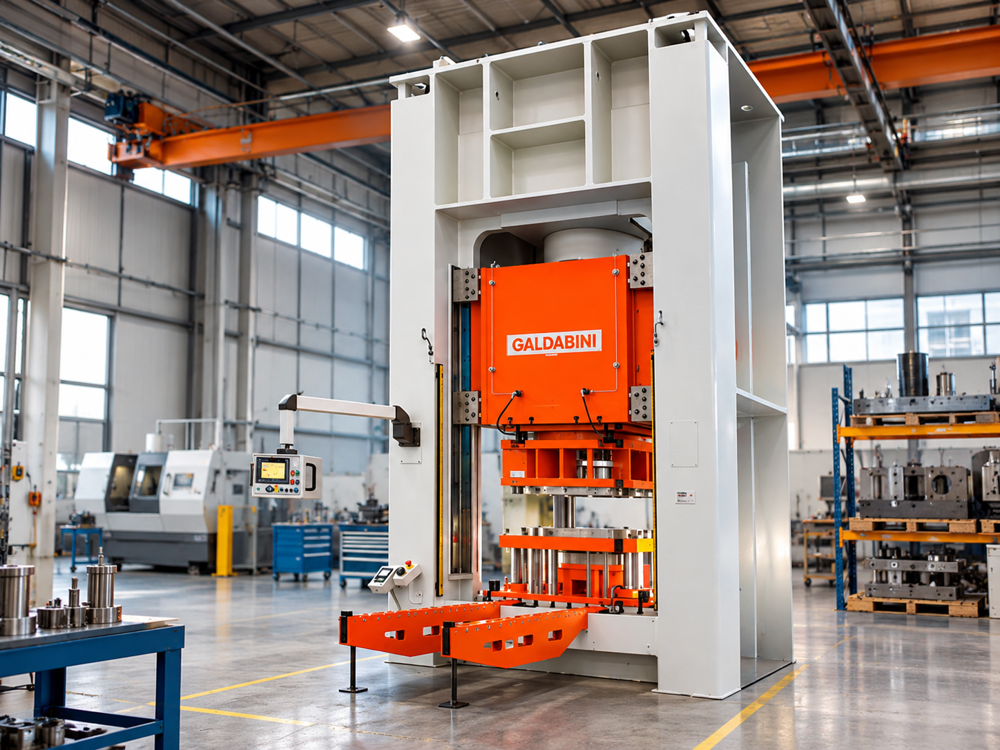
Mechanical presses are generally suited to high-speed repetitive operations, while hydraulic presses offer greater flexibility in adjusting force, speed and stroke. Hydraulic presses are particularly suitable for processes such as deep drawing, where it is necessary to control the deformation of the material over a significant portion of the stroke.
Which press to choose, then? The answer depends on the characteristics of the part to be produced, the material used, the force required and the production volumes. Understanding how the two technologies work is the first step in identifying the solution best suited to the needs of the industrial process.
How hydraulic and mechanical presses work
The fundamental difference between a hydraulic press and a mechanical press concerns the system used to generate and transmit the force to the die. In the first case the pressure of a fluid is used, while in the second the movement is produced by mechanical components driven by a motor.
This distinction determines how the force is available during the ram stroke and the possibilities for adjusting the movement according to the operation.
How the hydraulic press works
A hydraulic press uses the pressure of a fluid, typically oil, to drive one or more cylinders that generate the ram movement. The hydraulic system allows the application of the force required for the operation and the adjustment of parameters such as pressure, speed and position.
One of the main characteristics of this technology is the ability to make the nominal force available throughout the working stroke, within the performance limits provided by the machine. This aspect is particularly important in operations where the material must be deformed progressively, such as deep drawing.
The ram movement can be managed through different phases, for example a rapid approach to the die, a machining phase at controlled speed and the subsequent return. Parameter adjustment makes it possible to adapt the cycle to the characteristics of the material and the component to be produced.
In Galdabini hydraulic presses Galdabini, the design of the hydraulic circuit and the control of force, position and ram speed play a central role. These elements enable the development of solutions intended for industrial processes that require accurate process control, such as stamping, deep drawing and cold extrusion.
How the mechanical press works
A traditional mechanical press uses a transmission system that converts the motor's rotary motion into the ram's linear movement. In the most common configurations, energy is stored in a flywheel and transferred through a mechanism composed of elements such as a crankshaft, connecting rod and clutch.
The ram movement follows a trajectory determined by the geometry of the mechanism. Consequently, the available speed and force vary during the stroke, with the nominal capacity generally being reached near the bottom dead center, according to the constructive characteristics of the press.
This operation makes mechanical presses particularly suitable for processes that require rapid, repetitive cycles, such as blanking, punching and progressive stamping. In these processes, the ability to perform numerous cycles in short times can represent a significant advantage for productivity.
The lower flexibility in adjusting the movement compared to a traditional hydraulic press should not, however, be interpreted as lower precision. Mechanical presses can offer high levels of accuracy and repeatability, especially in applications for which they are designed.
It is also important to distinguish traditional mechanical presses from servo-driven mechanical presses, which introduce additional movement control possibilities and broaden the applications of this technology.
Hydraulic press vs mechanical press: the main differences
The main differences between hydraulic and mechanical presses concern the availability of force, processing speed, movement control and operating costs. These aspects influence productivity and determine the machine's suitability for different industrial applications.
Available force and pressure control
In hydraulic presses, the force is generated by the fluid pressure in the cylinders and can reach the nominal value at different positions of the stroke, within the machine's operational limits. It is also possible to adjust the applied force according to the operation.
In traditional mechanical presses, instead, the available force depends on the ram position and the geometry of the mechanism. The nominal capacity is generally reachable near the bottom dead center.
Hydraulic presses are therefore particularly suited to processes that require high and controlled forces over a significant portion of the stroke, such as deep drawing.
Working speed and cycle times
Mechanical presses are generally faster in repetitive operations, such as blanking and progressive stamping, where numerous cycles must be performed in short times.
Hydraulic presses instead offer greater flexibility in speed regulation. They can alternate rapid approach phases and controlled working phases, adapting the movement to the material's needs.
Productivity still depends on the machine configuration: an optimized hydraulic circuit can help significantly reduce cycle times.
Precision, repeatability and stroke control
Both technologies can ensure high precision and repeatability. Traditional mechanical presses follow a movement determined by the mechanism, particularly suitable for serial operations. Hydraulic presses allow the adjustment of force, position and speed of the ram during the different phases of the cycle.
The main difference therefore concerns the flexibility of control, rather than an absolute superiority in terms of precision. Servo-driven mechanical presses, moreover, offer broader adjustment possibilities compared to traditional models.
Energy consumption and maintenance
In traditional mechanical presses, the energy stored in the flywheel is transferred during the operation, a solution generally advantageous in high-rate productions.
In hydraulic presses, consumption depends on the operation of the pumps and the demand for pressure and flow. Advanced drive systems can improve energy efficiency by regulating operation according to actual production needs.
Maintenance also differs: for mechanical presses it mainly concerns transmissions and moving parts; for hydraulic presses it mainly involves fluid, filters, seals and the circuit.
Comparison table: hydraulic and mechanical press
| Characteristic |
Hydraulic press |
Traditional mechanical press |
| Available force |
Adjustable along the stroke |
Variable according to position |
| Speed |
Adaptable to the operation |
High in repetitive cycles |
| Control |
Flexible on force, stroke and speed |
Linked to kinematics |
| Repeatability |
High |
High |
| Deep drawing |
Particularly suitable |
Possible with specific configurations |
| High-rate stamping |
Depends on configuration |
Generally advantageous |
| Consumption |
Depends on the hydraulic circuit |
Often advantageous in fast cycles |
| Maintenance |
Hydraulic components |
Mechanical components |
The choice depends on production requirements: traditional mechanical presses generally prioritize speed in repetitive cycles, while hydraulic presses offer greater flexibility in managing force and movement.
When to choose a hydraulic press
A hydraulic press is particularly suitable when the operation requires precise control of force, speed and ram stroke. The ability to adjust these parameters allows the process to be adapted to the material characteristics and the geometry of the component to be produced.
Among the most representative applications is deep drawing, in which the material is progressively deformed to obtain components with even complex geometries. Hydraulic presses are also used for operations such as forming, stamping and cold extrusion, where controlled force management can contribute to the quality of the result.
This technology is also advantageous in productions that require frequent changeovers, thanks to the possibility of modifying operational parameters according to the part.
The choice of a hydraulic press must nevertheless consider production volumes and required cycle times: greater flexibility does not necessarily coincide with the most cost-effective solution for every application.
When to choose a mechanical press
A mechanical press is generally suitable for series productions that require fast, repetitive cycles and high volumes. The drive system makes it possible to reach high working frequencies, making this technology particularly suitable for operations such as blanking, punching and progressive stamping.
Traditional mechanical presses are advantageous when the operation requires a force compatible with that available in the useful part of the stroke and does not require frequent changes to the operating parameters.
The choice should also consider the part geometry, the material characteristics and the complexity of the die. For applications that require greater flexibility in movement control, servo-driven mechanical presses can also be considered, as they allow more articulated management of the ram speed profile compared to traditional configurations.
How to choose the press best suited to your production process
The choice between a hydraulic and a mechanical press must start from the characteristics of the operation and the production objectives. In addition to the drive technology, it is necessary to evaluate several parameters that directly affect machine performance.
- Material and component geometry: type, thickness and material behavior influence the force required and the deformation methods. Part geometry is also decisive: complex components or deep drawing operations may require articulated stroke control.
- Required force and die dimensions: tonnage must be sized according to the operation, also considering the position in which maximum force is required. It is also necessary to verify stroke, bed dimensions and available space for the die.
- Production volumes and cycle times: in high-rate productions, speed can be a priority criterion. For diversified operations or those characterized by frequent changeovers, the ability to adjust operational parameters becomes more important.
- Operating costs and automation: the evaluation should include energy consumption, maintenance, integration with loading and unloading systems and automation possibilities. The overall operating cost, together with expected productivity, makes it possible to compare solutions in the long term.
Galdabini hydraulic presses for stamping and deep drawing
Galdabini designs and manufactures hydraulic presses for industrial applications, with solutions dedicated to stamping, deep drawing and metal forming. Machines can be configured according to the characteristics of the component, production needs and the required level of automation.
Experience in designing hydraulic circuits makes it possible to optimize the relationship between installed power and working speed, contributing to improved cycle efficiency. Monolithic structures are designed to ensure rigidity and precision even in the most demanding operations.
An important role is also played by the control software, which allows management of process parameters, storage of recipes and monitoring of the production process. The ability to control ram force and position promotes operation repeatability and result verification.
From single presses to automated production lines, Galdabini develops customizable solutions to integrate hydraulic technology into different industrial contexts, with particular attention to productivity, process control and energy efficiency.
Frequently asked questions about the differences between hydraulic and mechanical presses
What is the main difference between a hydraulic press and a mechanical one?
The hydraulic press generates force through the pressure of a fluid, while the mechanical press uses a transmission system driven by a motor. The former offers greater flexibility in parameter adjustment; the latter is generally advantageous in fast and repetitive cycles.
Which press is faster?
Traditional mechanical presses are generally faster in high-rate productions. The performance of hydraulic presses depends instead on the circuit configuration and cycle optimization.
Which press is more suitable for deep drawing?
The hydraulic press is often preferred for deep drawing, thanks to the ability to control force and speed during material deformation. Some mechanical presses can also be used for these operations.
Which press consumes less energy?
There is no universal answer for all applications. Consumption depends on the drive technology, cycle frequency and operating conditions. Hydraulic presses with advanced regulation systems can significantly reduce energy demand.
Can a hydraulic press be used for series production?
Yes. Hydraulic presses can be integrated into automated production lines, with handling and control systems designed to ensure process continuity and repeatability.
Which press requires more maintenance?
It depends on the model and intensity of use. Hydraulic presses require checks on the circuit and the fluids, while mechanical presses require maintenance on the transmission and moving parts.
How to choose the correct tonnage for a press?
Tonnage must be determined considering material, component geometry, type of operation and maximum required force. For mechanical presses it is also important to verify in which position of the stroke the required force is available.