Generic
Straightening machines: types, technologies and applications in the sector

8/9/2026
In modern manufacturing industry, geometric precision is a fundamental requirement to ensure quality, reliability and production continuity.
During processes such as rolling, forging, machining or heat treatments, metallic components can undergo deformations that compromise the dimensional tolerances required by the design. Even a slight bend in a shaft, bar or tube can affect subsequent operations, assembly and, in some cases, the performance of the finished product.
To restore the correct geometry of components, straightening is performed: a process that applies controlled forces at the points where deformation is present, bringing the part back within the specified tolerances. This process not only improves the component's quality but also helps reduce rework, scrap and downtime, optimizing the entire production process.
The straightening machines are specifically designed to automate and control this process with high precision. Thanks to integrated measurement systems and the controlled application of force, they allow the straightening of bars, shafts, tubes and profiles in a repeatable and reliable way. Galdabini solutions include manual, automatic, horizontal automatic and Heavy Duty straighteners, configurable according to the component to be processed and the customer's production needs, finding applications in sectors such as automotive, precision engineering, oil & gas and metal profile production.
What a straightening machine is
A straightening machine is an industrial system designed to correct deformations present in metallic components, restoring them to the geometry specified by the design. Through measurement systems and the controlled application of force, these machines enable targeted interventions on deformed points, ensuring high precision, repeatability and part quality. Straightening machines are used to process a wide range of components, including bars, shafts, tubes, half-shafts, drive shafts, racks and metal profiles, ensuring compliance with the dimensional tolerances required before subsequent machining or assembly.
How a straightening machine works
The operating principle of a straightening machine is to identify the component's deformations and apply a controlled force exclusively at the points where geometry correction is necessary. In the most advanced solutions, the process is supported by integrated measurement systems that accurately detect the magnitude and position of the deformation, enabling precise and repeatable interventions. This approach makes it possible to obtain perfectly aligned components, improving the finished product's quality and reducing the need for rework.
Why straightening is fundamental in production processes
Straightening represents a strategic stage in numerous industrial processes. Deformations generated during rolling, forging, heat treatments or machining can indeed compromise the component's geometric precision and affect subsequent operations. Correcting these imperfections means ensuring compliance with dimensional tolerances, improving the part's reliability and guaranteeing consistent quality throughout production.
In the most demanding sectors, such as precision engineering, automotive or oil & gas, even a minimal deformation can impact the component's performance, making straightening an indispensable step in the production process.
Main types of straightening machines
Each straightening process presents different requirements depending on the component to be processed, the piece's dimensions, the required tolerances and the level of automation of the production process. For this reason, there is no universal straightening machine: the choice of the most suitable solution depends on the specific application and the company's production objectives.
The Galdabini range includes manual, automatic, horizontal automatic and Heavy Duty straightening machines, designed to process different types of components and configurable according to customer needs. This approach makes it possible to create systems that are perfectly integrated into the production process, optimizing precision, productivity and final part quality.
Heavy Duty automatic straightening machines
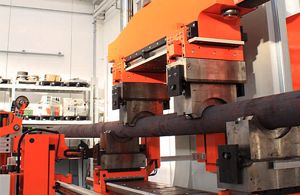
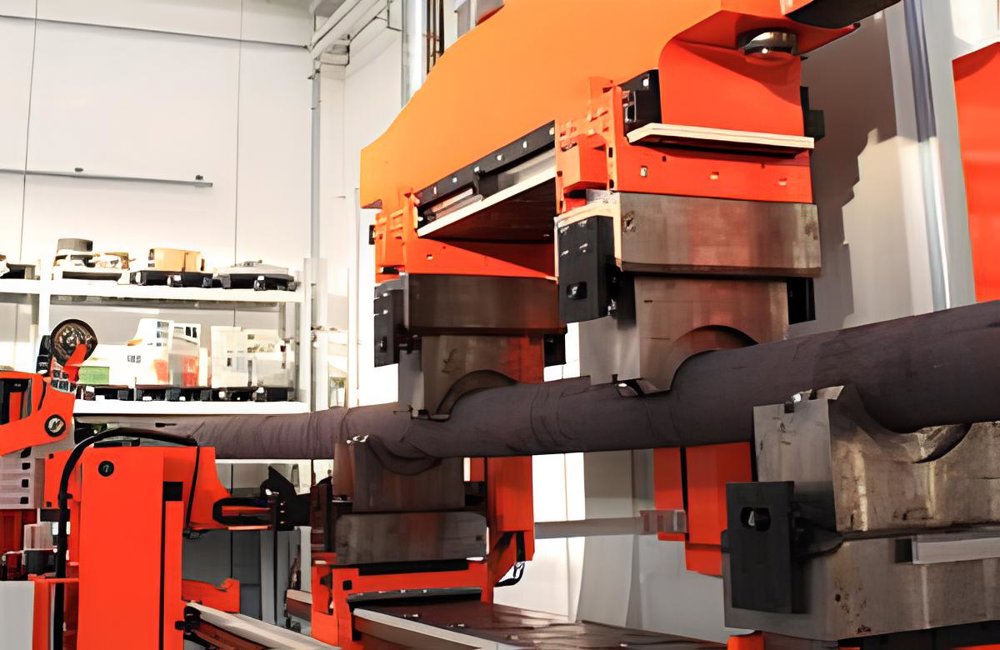
The Heavy Duty automatic straightening machines are designed for processing large-size components and high-strength materials, such as bars, tubes, railway axles and forged parts intended for the oil & gas, steel and heavy machinery sectors. In these applications it is essential to guarantee precision even on very long and heavy pieces, while keeping cycle times compatible with industrial production.
This family includes the Gantry 300, Gantry 1500 and Twin 4000, developed to handle heavy-duty work through advanced measurement systems, process automation and customizable configurations according to the component characteristics. Heavy Duty solutions can also be integrated with automatic loading and unloading systems, helping to increase productivity and reduce operator intervention.
Automatic straightening machines
The automatic straightening machines are the ideal solution for the production of components that require high precision, repeatability and operational continuity. They are used to straighten shafts, half-shafts, camshafts, racks, tools and many other mechanical parts used in the automotive, transport, precision engineering and industrial manufacturing sectors.
The range includes models PAS 4, PAS 12, PAS 25, PAS 30, PAS 50, PAS 120, as well as the Ring 12 and Ring 25 straighteners, developed for specific applications. Thanks to integrated measurement systems and automatic process control, these machines can precisely identify deformations and apply force only where necessary, improving component quality and reducing rework and scrap.
Horizontal automatic straightening machines
For some applications, horizontal straightening is the most effective solution. The Twin 60 is designed for processing profiles, linear guides, racks, bars and other long components, combining longitudinal straightening and torsion correction in a single machine.
Unlike traditional vertical systems, the piece is freely supported on the supports while the force is applied horizontally. Continuous laser scanning measurement allows detection of deformation along the entire length of the component before, during and after the straightening process, ensuring full control and 100% inspection of produced parts.
Manual straightening machines
Alongside fully automatic systems, Galdabini also offers manual solutions such as the S 300, intended for applications requiring greater operational flexibility, limited production runs or specific machining. While maintaining the high quality standards typical of precision straightening, these machines allow the operator to intervene directly in the process, representing an effective solution for particular production needs.
Technologies that make a difference in straightening
Today a straightening machine does not only apply a force to a deformed component. Technological evolution has transformed these systems into advanced solutions capable of measuring, analyzing and correcting deformations with high precision, improving process control and the quality of the final component.
Advanced measurement systems
One of the most important aspects of modern straightening is the ability to accurately identify the magnitude and position of the deformation before intervening. Galdabini straighteners integrate advanced measurement systems that make it possible to identify the points where force should be applied, making the process highly repeatable and reducing the risk of unnecessary interventions.
This approach allows improving the geometric precision of components and optimizing subsequent operations, contributing to reduced rework and scrap.
Laser technologies for non-contact measurement
For applications requiring even higher levels of precision, Galdabini has developed optical measurement technologies integrated directly into its straighteners. The LASER SCAN and LASER TUBE systems enable non-contact measurements, eliminating wear of measuring tools and any influence on the component during inspection.
In particular, LASER SCAN accurately detects linearity error along the entire length of bars and profiles, while LASER TUBE is designed to measure the internal straightness of tubes and bored cylinders, identifying the position and magnitude of deformation to allow correction by straightening the external diameter.
Production process automation
Modern straightening machines can be integrated within automated production lines, communicating with handling systems, automatic loading and unloading and other equipment in the plant. Automation increases productivity, improves process repeatability and reduces operator intervention, making straightening a phase perfectly integrated into the production flow.
For Heavy Duty applications, for example, Galdabini straighteners can be equipped with automatic handling systems designed according to the plant layout and the customer's production flow.
Customized solutions for every application
Each straightening process has specific characteristics related to the component type, piece dimensions, production volumes and required tolerances. For this reason, Galdabini straightening machines are not conceived as standard machines but as configurable and customizable solutions according to the application needs.
From the choice of measurement technology to the level of automation and integration with the rest of the production line, each machine can be designed to fit the customer's process, helping to maximize productivity, precision and finished part quality.
Where straightening machines are used
Straightening machines are employed in numerous industrial sectors where component geometric precision is an essential requirement. The ability to correct deformations in a controlled way improves product quality, reduces scrap and ensures compliance with tolerances required for subsequent operations. Thanks to the wide range of available solutions, Galdabini straighteners can be configured for very different applications, adapting to the component characteristics and the production process.
- Automotive, transport and e-mobility: in the automotive sector, straightening is a fundamental step to bring components that may deform during machining or heat treatments back within tolerance. Drive shafts, half-shafts, gearbox shafts, camshafts and steering racks require high levels of geometric precision to ensure reliability, safety and long-term performance. Galdabini straighteners make it possible to automate this process, improving the finished component's quality and reducing rework and scrap.
- Oil & Gas, steels and forgings: the production of bars, tubes and forged components for the oil & gas, steel and energy sectors requires particularly high dimensional standards. During rolling, forging or heat treatments, deformations can occur that must be corrected before further processing. Galdabini straightening machines are designed to work on even very large components, guaranteeing precision, productivity and reliability even in the most demanding applications.
- Precision engineering: when working with components intended for high-precision systems, even minimal deformation can compromise the correct functioning of the final product. For this reason, straightening is an essential stage in the production of elements such as ball screw shafts, rotors and medical tools, where compliance with dimensional tolerances is decisive. Thanks to integrated measurement systems and accurate control of the applied force, Galdabini straighteners enable components with perfectly aligned geometries and consistent quality.
- Metal profiles: linear guides, elevator guides, racks and other metal profiles require uniform geometry along their entire length to ensure correct functioning in final applications. Straightening machines allow correction of deformations by intervening only at necessary points, preserving component precision and improving the efficiency of the entire production process. This approach makes it possible to achieve high quality standards even in the production of profiles for particularly demanding industrial applications.
Why choose a Galdabini straightening machine
The choice of a straightening machine depends not only on the type of component to be processed but also on the manufacturer's ability to develop a solution truly suited to the production process. Each company has different needs in terms of materials, geometries, production volumes, level of automation and required precision.
For this reason, Galdabini straightening machines are designed as customizable, configurable solutions depending on the component to be straightened and the customer's specific requirements. From the choice of measurement technology to the level of automation, up to integration with handling systems and production lines, each machine can be adapted to optimize the process and maximize productivity.
The wide range of manual, automatic, horizontal automatic and Heavy Duty straightening machines makes it possible to cover applications ranging from precision engineering to the processing of large bars and tubes, always maintaining high standards of precision, repeatability and reliability.
Thanks to this design flexibility and the know-how gained in industrial straightening, Galdabini is able to offer solutions that integrate effectively into modern production processes, helping to improve the final component's quality and the overall efficiency of production.
We answer your frequently asked questions about straightening machines
Which components can be straightened with a Galdabini straightening machine?
Straightening machines are used to correct deformations of numerous metallic components, including bars, shafts, tubes, half-shafts, drive shafts, racks and metal profiles. The choice of the machine depends on the piece's dimensions, material, required tolerances and the process automation level.
On what basis should I choose a manual or an automatic straightener?
The main difference concerns the level of automation of the process. In manual straightening machines the operator locates the deformation point and applies the force necessary for correction. Automatic straightening machines, instead, integrate measurement and control systems that automatically detect the deformation and manage the straightening process, improving productivity, repeatability and component quality.
How to choose the most suitable straightening machine?
The choice depends on several factors: type of component, dimensions, material, required precision level, production volumes and desired automation degree. For this reason Galdabini offers a range of configurable and customizable straightening machines, developed to adapt to the customer's specific application needs.
What advantages does an automatic straightening machine offer?
An automatic straightening machine makes it possible to increase productivity, improve process repeatability and reduce the risk of errors due to manual intervention. Thanks to integrated measurement systems and automatic control of the applied force, it is possible to obtain components conforming to required tolerances with greater continuity and quality.
Is it possible to integrate a straightening machine into an automated line?
Yes. Galdabini straighteners can be integrated with automatic loading and unloading systems, anthropomorphic robots, electromechanical portals and other handling solutions, depending on the plant layout and production flow. This allows the straightening process to be automated and the overall production efficiency to be improved.
Are Galdabini straightening machines customizable?
Yes. All Galdabini straightening machines can be configured based on the component to be processed, the production process and the customer's requirements. Customization can concern the measurement technology, the level of automation, the handling systems and integration with the rest of the production line, so as to deliver a solution perfectly suited to the specific application.