Technical details
Choosing a hydraulic press: types, applications and selection criteria

7/5/2026
Hydraulic presses are among the most used machines in the manufacturing industry for operations that require force, precision and process control. From sheet metal forming to deep drawing, to the production of components intended for the automotive, aerospace and pressure vessel sectors, these solutions are a key element to ensure quality, repeatability and production efficiency.
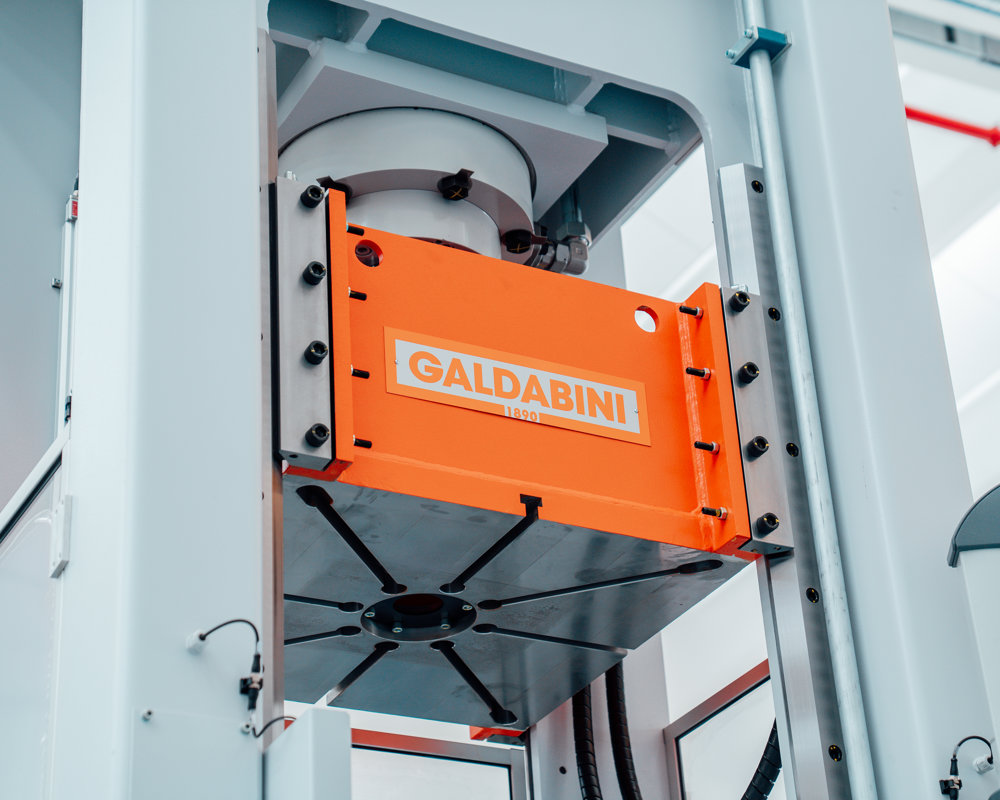
However, there is no single hydraulic press suitable for every need. The choice depends on numerous factors, including the type of process, the material to be transformed, the required force, the level of automation and the company's production goals. Understanding the differences between the various types of presses makes it possible to identify the most suitable solution, avoiding oversizing or suboptimal configurations.
In this guide we will analyze the main types of hydraulic presses, the criteria to consider when choosing, and the main industrial application areas. We will also see how the Galdabini range, which includes models such as C 70, EVL 120, EV 315, EV 400, EV 630, EV 800, EV 1000, EV 1500 and integrated automatic lines, is designed to meet the needs of very different production sectors, with solutions developed to combine performance, precision and operational continuity.
What is a hydraulic press
A hydraulic press is an industrial machine designed to generate high compressive forces through a hydraulic system. Thanks to the ability to precisely control force, stroke and speed, it is used in numerous production processes that require plastic deformation, forming, deep drawing, blanking, assembly and shaping of materials.
Its operating principle is based on the transmission of the pressure of an incompressible fluid inside a hydraulic circuit. The generated energy is converted into mechanical force via one or more cylinders, allowing controlled movements and high performance even in the most complex processes.
Compared to other pressing technologies, hydraulic presses offer extremely precise control of the entire production cycle. The ability to adjust parameters such as force, speed and stroke allows the machine to be adapted to different materials, geometries and processes, improving the quality of the finished part and the repeatability of operations. For this reason they are employed in numerous industrial sectors, from sheet metal forming to deep drawing, up to the production of components for automotive, aerospace, cookware, houseware and pressure vessel industries.
The advantages of a hydraulic press
Adopting a hydraulic press offers numerous production advantages. Chief among them are the ability to develop large working forces, the high precision of control throughout all phases of the cycle, and the possibility to process components with complex geometries while maintaining high quality standards.
Another strength is the versatility. The same technology can indeed be configured for very different applications, adapting to the production needs of companies in different sectors. In addition, modern hydraulic presses can be integrated into automated lines, helping to improve productivity, repeatability and process continuity.
How to choose a hydraulic press
The choice of a hydraulic press does not depend exclusively on the available tonnage. To identify the most suitable solution it is necessary to carefully evaluate the production process, the characteristics of the material to be processed and the production objectives. A correctly sized machine can improve cycle efficiency, reduce scrap and ensure consistent quality over time.
Force and tonnage
The first parameter to consider is the force required to perform the operation. Each application requires a certain tonnage, which must be sufficient to deform the material without compromising quality, safety or productivity. Correct sizing avoids both underutilization and oversizing of the machine.
Stroke and working dimensions
The cylinder stroke and the dimensions of the working table also directly affect the choice of press. These parameters must be compatible with the dimensions of the part and with the tools used during the production process.
Speed and productivity
In high-intensity industrial contexts, the cycle speed is a determining factor. A press designed to ensure the correct balance between installed power, working speed and process control allows optimization of cycle times without compromising process quality.
Automation and integration
Increasingly often hydraulic presses operate as an integral part of an automated production line. The possibility of integrating them with handling systems, robots, supervision software and process controls is a strategic element to improve efficiency, traceability and operational continuity. Galdabini solutions also include complete automated lines, designed to integrate into modern industrial processes.
The main types of hydraulic presses
Not all hydraulic presses are designed for the same production processes. The machine configuration, available force, structure and level of automation directly influence the type of processing that can be performed and the achievable performance. For this reason, knowing the main types of presses is the first step to identifying the solution best suited to your needs.
The Galdabini range includes different configurations, which are fully adapted and customized according to the customer's needs. From C-frame presses to presses for forming and deep drawing, to integrated automatic lines developed to meet specific production requirements in numerous industrial sectors.
C-frame presses
The C-frame presses are characterized by a structure that facilitates access to the working area, making them particularly suitable for operations that require quick part loading and unloading or frequent operator intervention. This configuration represents a versatile solution for numerous forming, assembly and shaping operations, especially when high accessibility to the working area is required.
Within the Galdabini range, the C 70 represents a solution designed to meet these needs, combining compactness, precision and operational reliability.
Presses for forming and deep drawing
When the production process requires deformation of sheet metal to obtain complex three-dimensional components, presses specifically designed for forming and deep drawing come into play.
These processes require accurate control of parameters such as force, stroke and speed, so as to ensure uniform deformation of the material and reduce the risk of defects during the production cycle. Presses dedicated to these applications allow the processing of components intended for many industrial sectors, maintaining high levels of precision and repeatability.
To meet these needs, Galdabini offers a range consisting of models such as EVL 120, EV 315, EV 400, EV 630, EV 800, EV 1000 and EV 1500, designed for applications that require high performance and operational continuity.
Automatic lines
In high-volume production, the press alone often represents only part of the process. For this reason, more and more companies choose to integrate the machine within an automated production line, where handling, automation and control systems operate in a coordinated manner.
The automatic lines make it possible to reduce cycle times, increase productivity and ensure greater uniformity of operations. The integration between press, automation and supervision systems also allows improved process control and production traceability, aspects increasingly important in modern industry.
Among the solutions developed by Galdabini are also complete automatic lines, designed to integrate into production processes and meet the needs of sectors such as automotive, sheet metal forming, cookware, houseware and pressure vessel production.
Which hydraulic press to choose based on the application
The choice of hydraulic press depends both on the machine characteristics and on the production process and the sector in which it will be used. Each application indeed has specific requirements in terms of force, precision, speed, automation and operational continuity.
Automotive
In the automotive sector, hydraulic presses are used for the production of structural and technical components obtained through stamping and deep drawing processes. In this field, precision, repeatability and productivity are fundamental requirements to ensure consistent quality and optimize production times.
Forming and deep drawing
Processes of forming and deep drawing require careful control of sheet metal deformation to obtain three-dimensional components with complex geometries. Hydraulic presses dedicated to these applications make it possible to manage force, stroke and speed precisely, improving part quality and process repeatability.
Aerospace
In the aerospace sector, the production of metal components requires high standards of precision and highly controlled processes. Hydraulic presses are used in operations such as forming and elastomer forming, contributing to the production of components that must meet particularly strict dimensional tolerances.
Cookware and Houseware
The production of pots, kitchen utensils and household items in metal requires drawing, blanking and stamping processes capable of guaranteeing aesthetic quality, surface uniformity and dimensional precision. In these contexts, hydraulic presses enable the production of components with complex geometries while maintaining high quality and production standards.
Gas cylinders, fire extinguishers and pressure vessels
The production of gas cylinders, fire extinguishers and pressure vessels also requires presses designed to handle complex processes characterized by high levels of control and production continuity. In these processes, integration with automatic lines is often a determining factor to optimize production and ensure product uniformity.
Why choose a Galdabini hydraulic press
Choosing a hydraulic press is not only about machine performance, but also about the reliability of the partner who designs, manufactures and supports it over time. In an industrial context increasingly focused on productivity, quality and operational continuity, being able to rely on a manufacturer that directly oversees every phase of the project represents a tangible value.
Galdabini develops its hydraulic presses internally, from mechanical design to hydraulic circuits, up to control systems and management software. This approach makes it possible to maintain control over the entire production chain, ensuring high quality standards, maximum integration between hardware and software and in-depth knowledge of every machine component.
Another distinguishing element is the ability to offer customized solutions. Each press can be configured according to the production process, the material to be processed and the customer's objectives, either as a stand-alone machine or as part of a complete automatic line. This flexibility makes it possible to meet the needs of very different sectors, from sheet metal forming to the production of components for automotive, aerospace, cookware and pressure vessels.
Completing the picture are Made in Italy, the experience gained over more than a century of activity and comprehensive technical support. Being developers of both the mechanical component and the software, Galdabini technicians can intervene with cross-disciplinary skills on the entire system, offering specialized support throughout the machine's lifecycle. This translates into faster response times, greater operational continuity and a single point of contact for any technical requirement.
Choosing the right hydraulic press means investing in your production process
Each industrial application presents specific needs and requires a hydraulic press designed to ensure the right balance between force, precision, speed and reliability. Carefully assessing the type of processing, the required level of automation and the material characteristics makes it possible to identify the most suitable solution and optimize the entire production process.
The choice of the machine should start from an analysis of the real production needs and the possibility of relying on a manufacturer able to follow the project at every stage. Thanks to in-house design and production, proprietary software development and a range of solutions dedicated to the main industrial sectors, Galdabini offers hydraulic presses designed to ensure high performance, process control and long-term reliability.
We answer frequently asked questions...
What is the difference between a hydraulic press and a mechanical press?
The main difference concerns the principle of operation. A hydraulic press uses one or more cylinders fed by pressurized fluid to generate the force required for processing, while a mechanical press uses transmission systems such as eccentrics, screws or flywheels. Thanks to the hydraulic system, hydraulic presses offer more precise control of force, speed and stroke throughout the work cycle, making them particularly suitable for applications such as stamping, deep drawing and sheet metal forming.
How to choose the tonnage of a hydraulic press?
Tonnage mainly depends on the material to be processed, the geometry of the part and the type of process to be carried out. An undersized press might not develop the necessary force, while an oversized one would result in higher costs and inefficient use of resources. For this reason it is advisable to evaluate the process as a whole, also considering stroke, speed, working table dimensions and the required level of automation.
When is it advisable to use a C-frame press?
C-frame presses are particularly recommended when high accessibility to the working area is required. Their configuration facilitates part loading and unloading operations and is ideal for processes such as assembly, stamping and forming of small and medium-sized components. In the Galdabini range, the C 70 represents a solution designed to combine compactness, precision and operational simplicity.
Can Galdabini hydraulic presses be customized?
Yes. In many cases a standard press is not sufficient to meet the needs of a specific production process. For this reason Galdabini hydraulic presses can be configured according to the application, defining parameters such as force, stroke, working table dimensions, level of automation and integration with other systems. This approach makes it possible to obtain a solution truly adapted to the company's production needs
Which materials can be processed with a hydraulic press?
Hydraulic presses can process mainly sheet metals such as steel, stainless steel, aluminum and special alloys. Depending on the application and machine configuration, they can be used to produce components intended for the automotive, aerospace, cookware, houseware and pressure vessel sectors.